
Owning a home in the Valley of the Sun comes with a lot of perks, from the year-round hiking weather to the growing culinary scene. However, every smart homeowner knows that the true cost of owning real estate goes beyond just the mortgage payment. One of the most important factors to understand before signing those closing papers is how the local government calculates your annual contribution to public services. For those moving from out of state, the way we handle property taxes in Phoenix Arizona might look a little different than what you are used to.
Arizona is often highlighted for having some of the lowest property tax rates in the country. This financial benefit is one of the primary reasons people flock to Maricopa County. But while the rates are low, the system uses specific terms like “Full Cash Value” and “Limited Property Value” that can be confusing at first glance. This guide breaks down exactly what you need to know about the current tax landscape in 2026, helping you plan your household budget with confidence.
How Property Taxes Are Calculated in Maricopa County
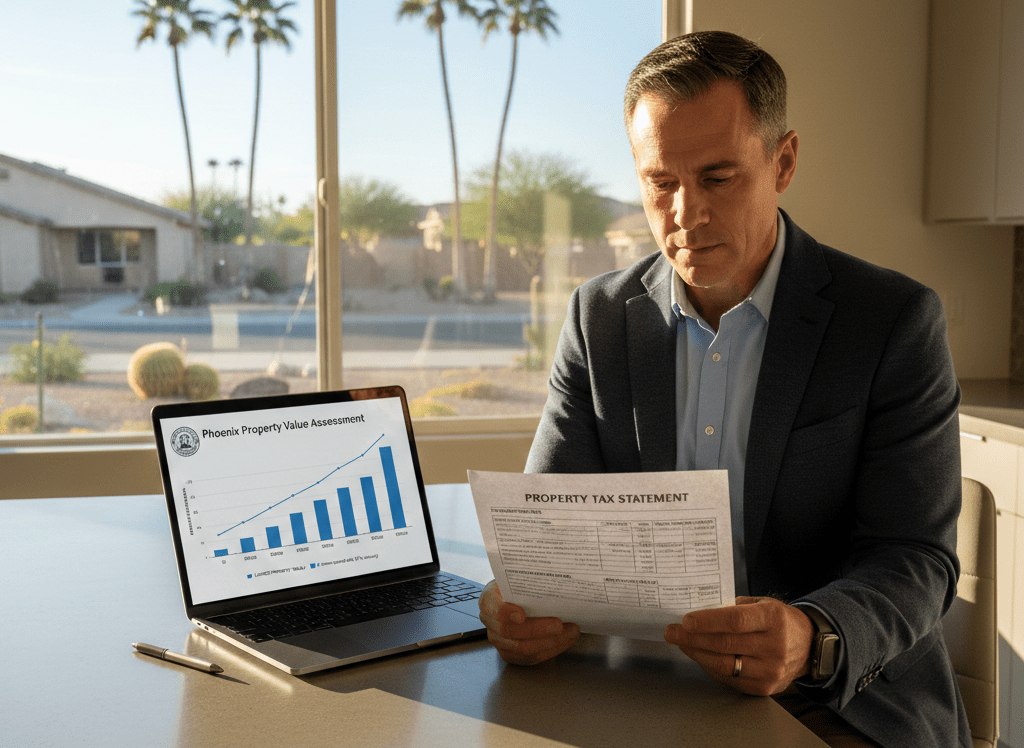
In Phoenix, your tax bill is not just a single number pulled from thin air. It is the result of a multi-step process managed by the Maricopa County Assessor and the Treasurer. The first thing to understand is that Arizona uses a two-tiered system: Primary Taxes and Secondary Taxes.
Primary taxes are used to pay for the basic operations of the city and county, like government salaries and road maintenance. Secondary taxes are usually voter-approved and go toward specific things like school bonds, library districts, or special infrastructure projects. When you look at your bill, you will see a list of different “taxing jurisdictions” that each take a small piece of the pie.
The Assessment Process
The County Assessor determines the value of your property about a year and a half before the bill actually arrives. For example, the values used for your 2026 tax bill were actually determined based on market conditions from mid-2023 to mid-2024.
Arizona also has a unique safeguard called the Limited Property Value (LPV). To prevent your taxes from skyrocketing just because the housing market is booming, the LPV cannot increase by more than 5% per year for most residential properties. This creates a “cap” that protects homeowners during periods of rapid inflation. If you are curious about how these costs fit into the bigger picture of relocating, you can read our guide on the cost of living in Phoenix Arizona explained to see how taxes, utilities, and housing prices interact.
Current Property Tax Rates in 2026
For the 2025-2026 tax year, the City of Phoenix has maintained a relatively stable primary property tax rate. Currently, the proposed primary rate is roughly $1.2658 per $100 of assessed valuation. When you add in the secondary tax rate of approximately $0.8141, the total city-level rate sits around $2.08 per $100 of assessed value.
However, it is important to remember that the “assessed value” for residential property in Arizona is only 10% of the Limited Property Value.
Example Calculation: If your home has a Limited Property Value of $400,000, your “Assessed Value” is $40,000. Using a simplified combined rate of $12.00 per $100 of assessed value (which includes county, school, and city taxes), your math would look like this: $40,000 / 100 = 400. 400 x $12.00 = $4,800 per year.
On average, most homeowners in the Phoenix area find that their effective tax rate is around 0.6% of their home’s total market value. This is significantly lower than the national average, which often hovers above 1%. If you are still in the shopping phase, looking at luxury homes in Scottsdale or other high-value areas will show you how these percentages can add up on more expensive estates.
Where Does Your Tax Money Go?
Many new residents wonder why their bill is split into so many different sections. Your property taxes in Phoenix Arizona fund the essential services that keep the city running.
- Public Schools: This is usually the largest portion of your bill. School districts rely on these funds for everything from teacher salaries to new building construction.
- Public Safety: A portion of your taxes goes directly to the Phoenix Police Department and the Phoenix Fire Department.
- Community Colleges: Maricopa County has one of the largest community college systems in the nation, and it is partially funded by property owners.
- Infrastructure: This includes maintaining the massive network of roads, bridges, and flood control systems required to manage the desert landscape.
If you are an investor looking to enter the market, understanding these local outflows is vital. Check out our investors guide to off-market rental properties in Phoenix for a deeper look at how tax rates impact your potential return on investment.
Important Dates and Due Dates for 2026
Arizona property taxes are paid “in arrears,” which means you pay for the current year in two installments.
- September 2026: The Maricopa County Treasurer mails out the tax bills.
- October 1, 2026: The first half of your taxes is due.
- November 1, 2026: The first half becomes delinquent if not paid.
- March 1, 2027: The second half of your taxes is due.
- May 1, 2027: The second half becomes delinquent.
Most people have these taxes paid automatically through their mortgage escrow account. If you own your home outright, you are responsible for making these payments directly to the Maricopa County Treasurer’s office.
Property Tax Exemptions and Relief Programs

Arizona offers several ways for homeowners to reduce their tax burden. If you qualify for these programs, it can save you hundreds or even thousands of dollars every year.
Widows, Widowers, and Disabled Persons
There is a specific exemption available for residents who have lost a spouse or who have a total and permanent disability. For the 2026 tax year, the allowable exemption amount is $4,873 off the Assessed Limited Property Value. There are income and property value limits to qualify, so you must apply through the Assessor’s office between January and March.
Senior Property Valuation Protection (The “Senior Freeze”)
If you are 65 or older and meet certain income requirements, you can apply to “freeze” the property valuation on your primary residence. While this does not freeze the tax rate, it prevents your property’s value from increasing for tax purposes as long as you live in the home. This is a massive benefit for those on a fixed income.
New 100% Disabled Veterans Exemption
Starting January 1, 2026, a new Arizona state law has gone into effect that offers significant relief to veterans. Veterans with a 100% service-connected disability rating are now eligible for a full property tax exemption on their primary residence. This is a major change designed to support those who served and to ensure housing stability for their families.
Comparing Phoenix to Other Markets
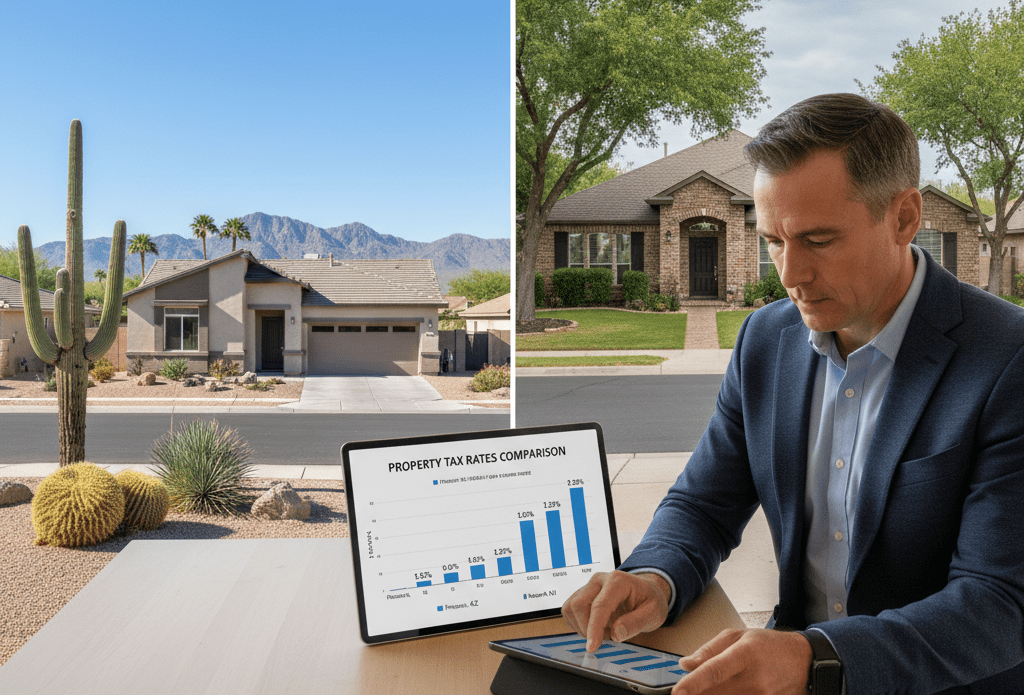
When you look at property taxes in Phoenix Arizona compared to other major cities, the Phoenix area remains a bargain. In states like Texas or New Jersey, effective tax rates can be double or triple what we pay in the Valley. This lower tax environment allows homeowners to afford more “house” for their money.
Even when compared to our neighbors in Georgia, Arizona often comes out ahead in terms of pure property tax percentage. While Arizona has a slightly higher sales tax, the low property tax makes it very attractive for retirees and long-term investors who want to minimize their recurring annual costs.
How to Appeal Your Property Valuation
If you receive your Notice of Value in the mail and believe the Assessor has overvalued your home, you have the right to appeal. You generally have 60 days from the date the notice was mailed to file a “Petition for Review of Real Property Valuation.”
To win an appeal, you usually need to provide evidence. This can include:
- Comparable Sales: Recent sales of similar homes in your immediate neighborhood that sold for less than your assessed value.
- Appraisals: A professional appraisal from a certified appraiser.
- Physical Evidence: Photos or documentation showing that your home has damage or issues that make it worth less than the Assessor’s estimate.
Official Resources for Phoenix Homeowners
For direct access to your specific tax bill or to make a payment, the Maricopa County Treasurer’s Office is your primary point of contact. This office is responsible for mailing the annual bills every September and collecting the installments in October and March. Their website offers a convenient portal where you can look up your property by address or parcel number to see exactly what you owe and where your tax dollars are being distributed among local school districts and city services.
Frequently Asked Questions
Why did my property tax go up if my value stayed the same?
Even if your property value does not change, the local taxing jurisdictions (like your school district or city council) can vote to increase their tax rates or pass new bonds. These small increases across several different districts can result in a higher total bill.
Is there a property tax on cars in Arizona?
Arizona does not have a “property tax” on vehicles in the traditional sense, but you do pay a Vehicle License Tax (VLT) when you register your car every year. This is based on the value of the vehicle and decreases as the car gets older.
What happens if I don’t pay my property taxes?
If taxes remain unpaid, the county will eventually sell a “tax lien” on your property. This allows an investor to pay your taxes for you in exchange for the right to collect interest. If the taxes remain unpaid for several years, the lien holder can eventually foreclose on the property.
Can I pay my full year’s tax at once?
Yes. While the county splits it into two payments for convenience, you are more than welcome to pay the entire annual amount in October.
Conclusion
Navigating the world of property taxes in Phoenix Arizona does not have to be a source of stress. By understanding the timeline of the assessment process and the difference between primary and secondary taxes, you can effectively manage your homeownership costs. Phoenix continues to be a premier destination for those seeking a high quality of life with a manageable tax burden.